

Opera Hat
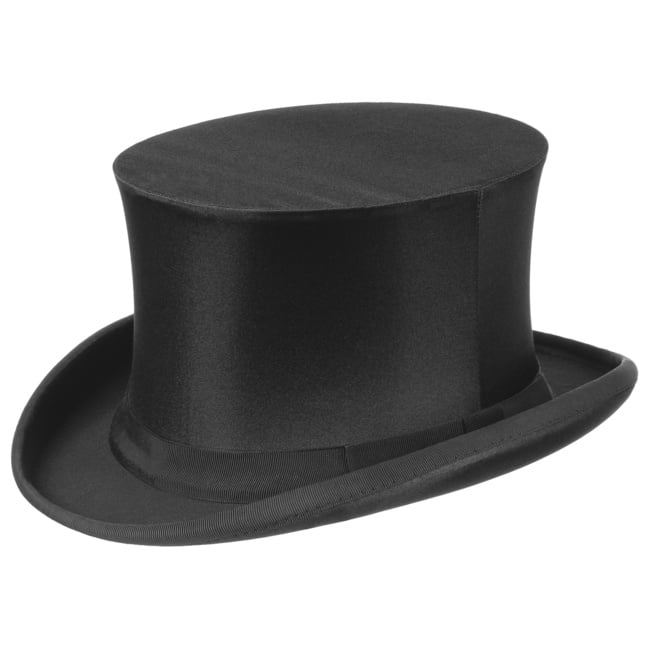
What is an opera hat? The term "Opera hat" is another name for the collapsible top hat, which is probably better known as "Chapeau Claque". When entering the theatre, one would remove the top hat, fold it, and carry it under the arm. Like the regular top hat, the opera hat is a tall, stiff hat with a cylindrical crown and a continuous, firm brim. It was usually black, often had a red lining, and was preferably made of silk or satin. Like the normal top hat, the opera hat was usually worn only for special, festive occasions, such as in the theatre.
The history of the top hat dates far back, with the opera hat emerging around 1830 as a new variant of the ordinary top hat. Thanks to the special folding mechanism, the cumbersome top hat became much easier to transport and more practical, easily folding up and fitting into a pocket. For the production of an opera hat, a plate of shellac is used for the hat's brim, which is covered with satin on both sides. These two parts, the brim and the crown, are then sewn together. The special feature here is the folding mechanism, which is realised by a special wireframe inside the crown.
Today, an opera hat, like the ordinary top hat, is rarely worn - and if so, only for elegant, special occasions and in stylish combination with a tailcoat or cutaway. One area where the opera hat is still used is dressage riding.