History:
![]() Linen
Linen
The beginnings of linen
Linen or flax are the terms used for the fibres and the resulting woven textiles made from the flax plant. Flax is one of
the oldest crops and it is believed that linen processing has been around for 10,000 years. The first documented finds
date back to 5,000 BC and show that linen was used early on, primarily in Egypt, Mesopotamia and Phoenicia. At the time,
white linen was a sign of purity, which is why Egyptian priests also wore linen textiles and mummies were wrapped in
linen cloths. From Greek and Roman antiquity to the later European Middle Ages, linen was the most important raw
material for textiles and clothing, in addition to wool. During the Middle Ages linen was primarily used for
close-fitting clothing because of its dirt-repellent properties, and also for fabric armour because of its strength.
Linen today
Linen experienced its heyday in pre-industrial Europe and, together with wool, was the most manufactured textile up until
the 19th century. Since cultivation required manual labour at the time, during the 19th century linen was almost
completely superseded by the cheaper, increasingly imported cotton textiles, for which there were already mechanical
manufacturing processes. Linen was mainly manufactured in Ireland, Holland, Westphalia, Saxony, Silesia and Bohemia.
Since the end of the 20th century, linen has gained importance once again as an environmentally friendly, plant-based
natural fibre. Linen fibres are gathered from the stems of the flax plant and are classed as bast fibres.
The structure
Unlike cotton, the individual fibres (2.5-6 cm), which are made of cellulose, form fibre bundles (50-90 cm) through
pectin, which must first be separated from one another. The harvest takes place between July and August when the plants
have reached a height of approx. 80-120 cm and the flowers are a white to light blue colour. During the process the
plants are plucked from the ground using a special machine and deseeded. These steps are also called raking and ribbing.
Then the plant is dried, during which time the pectin rots away (naturally when lying in the field or artificially under
flowing water) and the bast can later be removed from the stem more easily. Finally, the stem is broken several times to
achieve the desired separation. The remaining wooden parts are separated out by swinging them in a turbine. Once only
the fine fibres are left (approx. 4 cm), they can be further processed and spun into a yarn at a short-staple mill.
Properties:
Hygienic and pleasant to wear
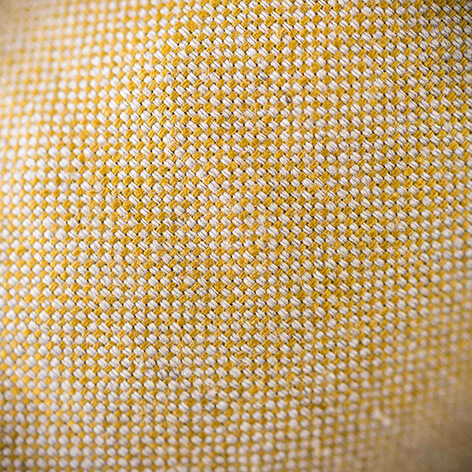
The colour of linen varies from white to cream to a greyish brown, but is easy to bleach white and then dye in other
colours. Linen fibres are easy to divide and can be finely spun, which makes it especially interesting for producing bed
linen and clothing. In addition, the fibres are very smooth, so the weave does not have much air in it, making it
lint-free and less prone to gathering dirt and bacteria. The fibres are inherently bactericidal, dirt-repellent,
breathable and almost completely antistatic. Due to its antibacterial and water retaining properties, linen always
ensures low moisture content, prevents the development of bacteria and also absorbs odours. These odour-neutralising
functions make linen popular for insoles and the inner lining of shoes. Linen also works as a water-binding agent and
can absorb up to 35% humidity, quickly replacing it with ambient air. This ensures optimal temperature regulation,
making linen cool in warm temperatures and warm in cold temperatures.
A different appearance depending on the treatment
Thanks to its good ability to absorb moisture, flax is a very comfortable fibre, which can absorb sweat easily and
quickly, and which feels very soft to wear. Linen fibres are also very tear-resistant, hard-wearing and long-lasting,
however, they are also inelastic, which makes them susceptible to abrasion and wrinkling. Linen has a natural freshness
when ironed damp and does not require any starch because it has a natural shine. Because it is so durable, each wash
makes it softer and shinier rather than worsening its quality, so a linen item that has been worn many times can look
and feel like silk. A quality label distinguishes between pure linen and half linen. The linen content of pure linen
must be 100% and half linen must have at least 40% linen content, whereby the warp is pure cotton and the weft is pure
linen.
Care tips:
Before washing
When washing, care should be taken to ensure the washing machine is only half full and the washing should be left to soak
a little beforehand. In addition, only detergents without optical brighteners should be used, such as a neutral soap,
mild detergent or all-in-one detergent for coloured fabrics. Coloured and unbleached linen should be washed inside out
on a gentle cycle at a maximum of 40 °C. However, we advise always paying attention to the water temperature listed on
the specific item's care label. Linen can sometimes be washed at higher temperatures. Whether you're washing by hand or
using a machine: Linen should always be rinsed well to avoid staining caused by oxidation of the cellulose. Linen
textiles should only be spun on the lowest setting and ironing should only be done when the item is damp, as dry heat
can damage the linen. It is advisable to use a steam iron.
After washing
It is also important to know that ironing gives linen a shiny effect. If you would rather have a matte, dull surface of
the fabric, iron the item inside out. Because linen is less elastic than other fibres, it is relatively prone to
creasing. Care should therefore be taken not to wash the items folded up, not to put them into the tumble dryer if
possible, and to wrap them in tissue paper when packing a suitcase. Before drying, linen products should always be
stretched a little and then hung dripping wet on a washing line, but never in direct sunlight. If the linen textiles are
suitable for tumble drying, you can put them in a fairly empty drum and dry them on a low temperature. We recommend
washing new linen textiles on their own during the first wash. Very delicate laundry should also be placed in a
pillowcase before being washed in the washing machine.
Conclusion:
Positives outweigh the negatives
Linen has lots of positive properties, is a renewable raw material and is used in many fields. Thanks to its various
functions, linen is particularly suitable for those with allergies, people with sensitive skin or for wearing in hot
temperatures. So it is primarily used for clothing (especially summer clothing: Shirts, trousers, jackets, blouses,
suits, etc.), table and bed linen, bed sheets, decorative fabrics, curtains, kitchen towels, for covering books or
screens, or for use in tents and backpacks.
The uses are almost limitless
The plant stems can also be used, for example, to make wallpaper and mailbags. In addition, moulding plates are often
made from flax plant straw. Even the seeds of the plant can be used. They are used to produce linseed oil and create
animal feed. The short fibres, which are produced as a by-product of the linen extraction process, are also used as
insulation. All of this makes linen a very environmentally friendly material as all of the parts of the plant can be
used in new ways.