History:
![]() Cashmere
Cashmere
Soft and pleasant
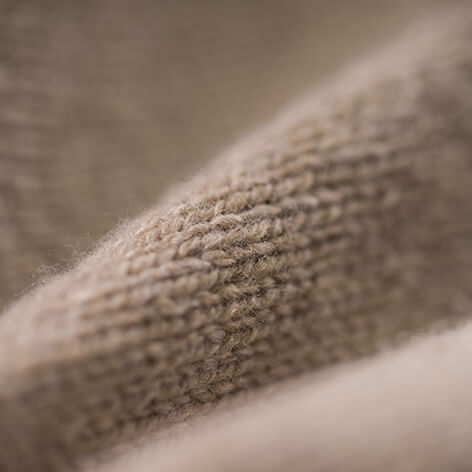
Cashmere wool (also referred to simply as "cashmere") is an exceptionally soft and fine natural fibre. It is made from
the undercoat of the cashmere goat. The name derives from the Kashmir region in the highlands of southern Asia, which is
home to the cashmere goat. The cashmere goat belongs to the caprine family and is a sub-species of woolly goats. They
are flop-eared, have horns and come in around 20 different breeds. The colour shades include white, grey, brown and
black.
Cashmere - a long history
High quality cashmere wool has been made into first-class textile products in the Kashmir region since around 1,000 BC.
Today, the main producer countries are China, Iran, Mongolia and Pamir (Central Asian highlands). There are also large
farms that specialise in breeding cashmere goats in New Zealand, Australia and Scotland. Cashmere wool is manually
combed out of the goat's undercoat when they moult at the end of the winter. Nowadays, some goats are also mechanically
shorn. Sorting of the fleece is carried out by hand according to fineness and colour.
Properties:
Utterly exquisite
Cashmere is one of the most expensive and precious natural textiles, which is mainly due to its scarcity. The annual
yield per animal is just 150-200 g, which is roughly enough for one scarf. Alongside the scarcity of the raw material,
the high price is also due to the complex extraction methods and the incomparable fineness and softness of the fibre, as
well as the excellent thermal properties of items made from cashmere. Today, you could pay between €120 and €200 for 1
kg of unprocessed cashmere wool, depending on its quality.
Warming wool
The undercoat of the cashmere goat is particularly fine and has a diameter of 15-19 micrometers and a length of 25-90 mm.
This fineness makes cashmere a precious wool which has the lowest weight with the best heat retention properties of all
natural precious fibres, thanks to the formation of tiny air holes for storing heat. This is why cashmere products are
often light as a feather but still incredibly comfortable to wear, offering incomparable softness that feels more like a
"second skin". Cashmere also has dirt and odour-repellent properties and is breathable. So there is no build up of air
and it does not make you sweaty. This is why you could wear a lightweight cashmere jumper or scarf, even in the summer.
Care tips:
Be careful when washing
When caring for cashmere, it is important that you do not wash cashmere textiles too frequently. As a rule, it is
sufficient to clean them after every third or fourth use. After wearing, it is helpful to leave the item of clothing for
a day before washing it or putting it back into the wardrobe. As cashmere has odour-repellent properties, it is often
enough to leave it to air out over night. Afterwards it is usually fresh, fluffy and soft again, as the fibres of the
material straighten themselves out. It is better to wash cashmere products using a washing machine's wool cycle rather
than washing them by hand, as this is gentler on the fibres. Items of clothing should not be turned inside out, the
washing machine should never be set higher than 30° and should only be half full. It is best to use a wool detergent.
Fabric softeners, however, should be avoided. If you have to wash the cashmere product by hand then it is important to
only ever use lukewarm water and never leave the item sitting in the water for a long period of time.
Take care when drying
After washing, the garment should be carefully rinsed with lukewarm water, very gently squeezed and then rolled up into a
hand towel to remove the excess moisture. Cashmere products can either be dried in the tumble dryer with cold air or
laid on a clothes horse with a hand towel underneath. Cashmere textiles should also be stored flat wherever possible and
not hung on a hanger in the wardrobe.
Conclusion:
Cashmere is not only special and precious because it is difficult to obtain and has a low yield. Its unique properties
make it the most exquisite and high quality wool variety. What sets cashmere apart from all other types of wool is its
extreme fineness, very high heat retention at an incredibly light weight, along with its matchless softness and
fluffiness. This is why it is often used for soft, cuddly jumpers, cardigans or scarves, which are not only light as a
feather but also very warm to wear. Thanks to all these properties, cashmere wool has a very special quality that makes
it such a sought-after and costly product.