

Chapeau Claque
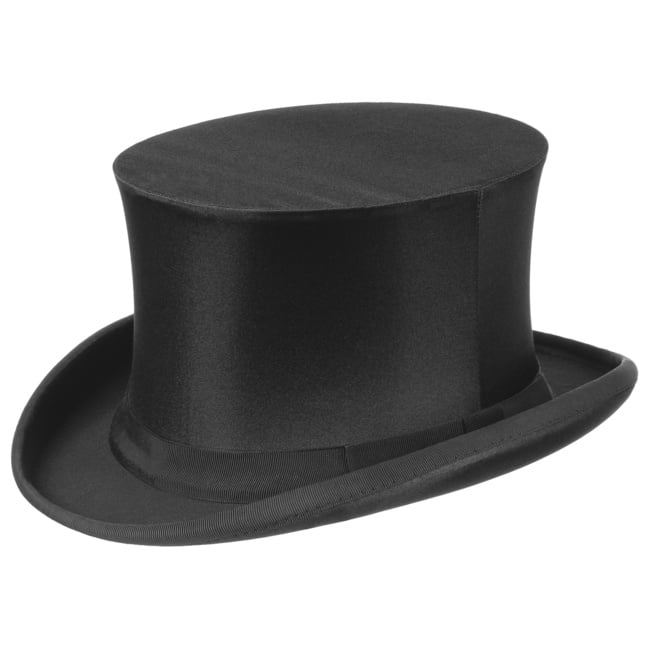
What is a Chapeau Claque? The term "Chapeau Claque" combines the French words "Chapeau" for the hat and "Claque" for the clap, describing a particular variant of the typical top hat, known as the "collapsible top hat," where the crown of the hat can be collapsed with a slight tap. Like the standard top hat, the Chapeau Claque is a tall, stiff hat with a cylindrical crown and a firm, encircling brim. Typically, the Chapeau Claque is black and often features a red lining. It is preferably made from satin or silkand is regarded as an exquisite hat, usually worn only on particularly festive and elevated occasions.
The history of the top hat dates back to ancient times, with the Chapeau Claque emerging around 1830 as a new variant. The folding mechanism made the unwieldy top hat more portable and practical, easily storable in a pocket or specially designed container. To make a Chapeau Claque, a plate of shellac is used for the top hat brim, covered on both sides with satin. Subsequently, the crown is lined and also covered with satin. These two parts, brim and crown, are then sewn together. The unique feature here is the folding mechanism, realised through a special wireframe incorporated inside the crown. This wireframe is tensioned and automatically springs open when the hat's brim is tapped with the flat hand.
Particularly exquisite Chapeau Claques are made from silk, which is, however, less suitable due to its delicacy. Silk can be easily damaged by the mechanism. For this reason, these special top hats are mostly made from satin, which is much more durable and resistant than silk.
One area where the top hat still sees regular use today is in dressage riding. In the higher classes, a top hat or a bowler is worn with the riding coat. A top hat is always worn with a tailcoat in the highest classes. Additionally, the top hat is often associated with magic, as it has always been used as a prop in magic shows, such as the famous trick where a rabbit or dove is pulled out of a top hat.